
Categories
TheSmokinApe Youtube

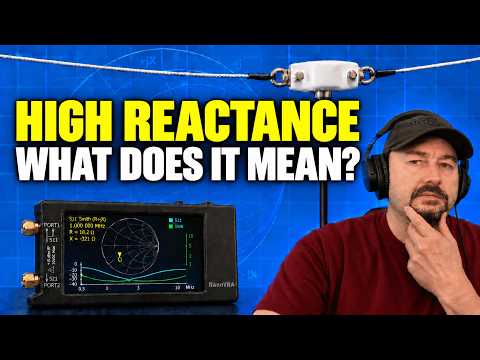
The TRUTH About High Feedpoint Reactance

What does high feedpoint reactance actually tell you about an HF antenna?

A large reactive component can indicate a serious impedance mismatch, but it does not automatically mean the antenna is inefficient, that reflected power is being lost, or that common-mode current is flowing on the coax.

In this video, we go beyond the analyzer reading and separate several concepts that are often mistakenly treated as the same problem:

• Feedpoint resistance and reactance
• Impedance mismatch, SWR, and reflected power
• Feed-line loss and impedance transformation
• Voltage and current stress
• Stored energy, antenna Q, and bandwidth
• Radiation efficiency
• Common-mode current and feed-system imbalance
• Common-mode choke performance
• VNA reference planes and feedpoint measurements

We’ll also develop a practical six-step diagnostic process for determining what a high-reactance measurement means in your particular antenna installation.

Reactance is valuable information, but it is only the beginning of the diagnosis.

If you enjoy technically detailed discussions about antennas, RF measurements, and amateur radio equipment, please consider subscribing for more content like this.

Thanks for watching!

👍Join this channel:
https://www.youtube.com/channel/UCdJlIoWR3mf7apfB1dXS97A/join

Links to products in the video:
👉 NanoVNA: https://amzn.to/4rCF2ai
👉 TinySA Ultra: https://amzn.to/3PGlAfk
As an Amazon Associate, I earn from qualifying purchases.

👉👉 Join The Ham Radio Project Discord: https://discord.gg/bgpwE5WF9p 👈👈

👍Support TheSmokinApe Channel on Patreon Here: https://www.patreon.com/TheSmokinApe

🔥🔥🔥 Get your Ham Radio License using Ham Radio Prep:
https://www.HamRadioPrep.com/?rfsn=8915836.d56e74
USE CODE "SmokinApe" for 20% OFF

Categories
TheSmokinApe Youtube

SWR vs Return Loss: Understanding Your Antenna Match

Most ham radio operators are familiar with SWR, but antenna analyzers and VNAs often give us another measurement: Return Loss. While both describe the quality of the impedance match, they express that information very differently, and the terminology can sometimes cause confusion.

In this video, we break down Return Loss and SWR from a practical ham-radio perspective, including how each measurement relates to the reflection coefficient (Γ) and S11.

Understanding the relationship between these measurements makes antenna analyzers and VNAs much easier to use, and helps prevent one of the most common sources of confusion in RF measurements: Return Loss is normally expressed as a positive number, while S11 in dB is normally negative.

Whether you’re building antennas, testing feed lines, evaluating matching networks, or just trying to understand what your analyzer is telling you, this video should help connect the dots between SWR, Return Loss, S11, and reflected power.

Sponsored by http://www.pcbway.com Cheap & quick PCB, 3D Printing, CNC machining, and fabrication services from PCBWay.

👍Join this channel:
https://www.youtube.com/channel/UCdJlIoWR3mf7apfB1dXS97A/join

Links to products in the video:
👉 NanoVNA: https://amzn.to/4rCF2ai
👉 TinySA Ultra: https://amzn.to/3PGlAfk
As an Amazon Associate, I earn from qualifying purchases.

👉👉 Join The Ham Radio Project Discord: https://discord.gg/bgpwE5WF9p 👈👈

👍Support TheSmokinApe Channel on Patreon Here: https://www.patreon.com/TheSmokinApe

🔥🔥🔥 Get your Ham Radio License using Ham Radio Prep:
https://www.HamRadioPrep.com/?rfsn=8915836.d56e74
USE CODE "SmokinApe" for 20% OFF

Categories
TheSmokinApe Youtube

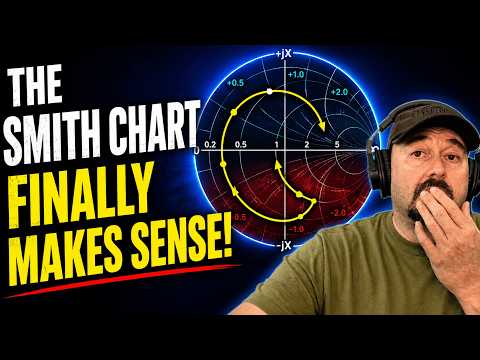
The Smith Chart Made EASY!

Learn about the Smith Chart, a fundamental tool for ham radio operators to visualize and understand complex impedance and reflection coefficient. The Smith Chart remains a standard RF tool, with its center representing a 50-ohm match and the outer boundary representing total reflection. It’s commonly used for antenna and feed-line impedance matching, helping to tune matching networks and move a load impedance toward the center of the chart for better power transfer. In this video, we’ll explore the basics of the Smith Chart, including constant-resistance circles, constant-reactance arcs, and normalization to a reference impedance. Whether you’re a seasoned ham radio operator or just starting out, understanding the Smith Chart is essential for one-port measurements and frequency-dependent impedance traces. Tune in to learn more about this essential tool and how to use it effectively for ham radio operations.

Sponsored by http://www.pcbway.com Cheap & quick PCB, 3D Printing, CNC machining, and fabrication services from PCBWay.

👍Join this channel:
https://www.youtube.com/channel/UCdJlIoWR3mf7apfB1dXS97A/join

Links to products in the video:
👉 NanoVNA: https://amzn.to/4rCF2ai
👉 TinySA Ultra: https://amzn.to/3PGlAfk
As an Amazon Associate, I earn from qualifying purchases.

👉👉 Join The Ham Radio Project Discord: https://discord.gg/bgpwE5WF9p 👈👈

👍Support TheSmokinApe Channel on Patreon Here: https://www.patreon.com/TheSmokinApe

🔥🔥🔥 Get your Ham Radio License using Ham Radio Prep:
https://www.HamRadioPrep.com/?rfsn=8915836.d56e74
USE CODE "SmokinApe" for 20% OFF

Categories
TheSmokinApe Youtube

Counterpoise vs Radial vs Ground Plane: What’s the Difference?

Learn the difference between an antenna ground plane, radial system, and counterpoise wire to optimize your RF current return path.

Many amateur radio operators confuse these return systems, leading to inefficient setups and unnecessary ground loss. This guide clarifies how each configuration functions as a return path for RF current, helping you determine which is necessary for your specific antenna installation.

We cover the technical distinctions between a resonant antenna setup and non-resonant designs. You will gain a clear understanding of how to manage RF radiation spectrum requirements effectively. By using the provided diagnostic matrix, you can match the correct return path to your antenna type, ensuring better performance and fewer signal issues.

Whether you are building a vertical antenna or adjusting a wire dipole, these foundational concepts allow you to make informed decisions about your station. Stop guessing about your grounding strategy and start building more efficient systems today.

Subscribe for antenna theory breakdowns, and comment below with which antenna project you are currently working on.

👍Join this channel:
https://www.youtube.com/channel/UCdJlIoWR3mf7apfB1dXS97A/join

Links to products in the video:
👉 NanoVNA: https://amzn.to/4rCF2ai
👉 TinySA Ultra: https://amzn.to/3PGlAfk
As an Amazon Associate, I earn from qualifying purchases.

👉👉 Join The Ham Radio Project Discord: https://discord.gg/bgpwE5WF9p 👈👈

👍Support TheSmokinApe Channel on Patreon Here: https://www.patreon.com/TheSmokinApe

🔥🔥🔥 Get your Ham Radio License using Ham Radio Prep:
https://www.HamRadioPrep.com/?rfsn=8915836.d56e74
USE CODE "SmokinApe" for 20% OFF

Categories
TheSmokinApe Youtube

The BIGGEST Myth About End Fed Halfwave Antennas!

Do you need a counterpoise for your EFHW antenna? This video breaks down the fundamental electronics, including Kirchhoff’s laws, to clarify how current actually flows in an EFHW antenna setup. Understanding these principles is essential for anyone trying to optimize their station and ensure their signal is radiating efficiently.

We also look at how to effectively use a common-mode choke to manage current flow. By adding a dedicated counterpoise, you can significantly improve antenna performance and resolve common RF interference issues. This technical walkthrough is designed for amateur radio enthusiasts who want to move beyond hearsay and understand the physics behind their equipment.

Subscribe for more antenna theory breakdowns, and let me know in the comments if you run your EFHW with or without a counterpoise.

👍Join this channel:
https://www.youtube.com/channel/UCdJlIoWR3mf7apfB1dXS97A/join

Links to products in the video:
👉 NanoVNA: https://amzn.to/4rCF2ai
👉 TinySA Ultra: https://amzn.to/3PGlAfk
As an Amazon Associate, I earn from qualifying purchases.

👉👉 Join The Ham Radio Project Discord: https://discord.gg/bgpwE5WF9p 👈👈

👍Support TheSmokinApe Channel on Patreon Here: https://www.patreon.com/TheSmokinApe

🔥🔥🔥 Get your Ham Radio License using Ham Radio Prep:
https://www.HamRadioPrep.com/?rfsn=8915836.d56e74
USE CODE "SmokinApe" for 20% OFF

Categories
TheSmokinApe Youtube

Balun Chokes & SWR: The Truth Revealed!

Learn about BALUN chokes and how they can improve your ham radio experience. If you’re a beginner in the world of ham radio, understanding the basics of BALUN chokes is essential for optimizing your radio’s performance. In this video, we’ll explore what BALUN chokes are, how they work, and why they’re crucial for ham radio operators. Whether you’re setting up your first ham radio station or looking to upgrade your existing equipment, this video will provide you with the knowledge you need to get started with BALUN chokes. From reducing interference to improving signal quality, we’ll cover it all. So, if you’re ready to take your ham radio skills to the next level, watch this video to discover the importance of BALUN chokes for ham radio beginners.

👍Join this channel:
https://www.youtube.com/channel/UCdJlIoWR3mf7apfB1dXS97A/join

Links to products in the video:
👉 NanoVNA: https://amzn.to/4rCF2ai
👉 TinySA Ultra: https://amzn.to/3PGlAfk
As an Amazon Associate, I earn from qualifying purchases.

👉👉 Join The Ham Radio Project Discord: https://discord.gg/bgpwE5WF9p 👈👈

👍Support TheSmokinApe Channel on Patreon Here: https://www.patreon.com/TheSmokinApe

🔥🔥🔥 Get your Ham Radio License using Ham Radio Prep:
https://www.HamRadioPrep.com/?rfsn=8915836.d56e74
USE CODE "SmokinApe" for 20% OFF

Categories
TheSmokinApe Youtube

Ape Answers 023 – Loop on The Ground Antennas for Ham Radio

Many amateur radio operators know that a Loop-on-Ground can outperform much larger antennas on receive, especially in noisy suburban and urban environments. But why does it work? Is it really because it’s a "magnetic antenna," or is there more to the story?

In this video, we dive into the physics behind the Loop-on-Ground antenna and separate fact from fiction. We’ll explore how electromagnetic waves are composed of both electric (E) and magnetic (H) fields, why local man-made interference behaves differently from distant DX signals, and how a LoG takes advantage of near-field physics to dramatically improve signal-to-noise ratio.

Whether you’re considering building your first Loop-on-Ground or simply want to better understand the science behind low-noise receive antennas, this video explains the concepts using clear illustrations and practical amateur radio examples.

As always, if you enjoy technically accurate amateur radio content focused on understanding the why behind RF, be sure to like the video, subscribe to the channel, and leave your questions or experiences with Loop-on-Ground antennas in the comments below.

Ape Answers is a short format video series where we answer Ham Radio related questions from viewers. We cover questions that were asked on my videos to get you that answers you are looking for. Whether you’re a beginner or an experienced user, we’ve got you covered with detailed explanations and solutions to common issues. Tune in to get your questions answered!

👍Join this channel:
https://www.youtube.com/channel/UCdJlIoWR3mf7apfB1dXS97A/join

Links to products in the video:
👉 NanoVNA: https://amzn.to/4rCF2ai
👉 TinySA Ultra: https://amzn.to/3PGlAfk
As an Amazon Associate, I earn from qualifying purchases.

👉👉 Join The Ham Radio Project Discord: https://discord.gg/bgpwE5WF9p 👈👈

👍Support TheSmokinApe Channel on Patreon Here: https://www.patreon.com/TheSmokinApe

🔥🔥🔥 Get your Ham Radio License using Ham Radio Prep:
https://www.HamRadioPrep.com/?rfsn=8915836.d56e74
USE CODE "SmokinApe" for 20% OFF

Categories
TheSmokinApe Youtube

Ape Answers 022: Man Made RF Noise Interference

Reduce RF noise interference by understanding how your HF ham radio antenna setup interacts with man-made electrical noise. Learn to improve your reception.

This video examines the physics behind RF noise interference and why specific antenna designs struggle more than others in noisy environments. If you are struggling with a high antenna noise floor, this breakdown clarifies how different antenna types react to local interference sources. It is designed for radio operators looking to optimize their station performance by understanding the root causes of signal degradation.

We focus on the practical differences between vertical and horizontal antennas, specifically regarding their susceptibility to man-made interference. By analyzing the interaction between these designs and common noise sources, you will gain a clearer understanding of how to manage your signal to noise ratio effectively. Choosing the right antenna is often the most critical step in clearing up your receiver.

Subscribe for weekly antenna physics and radio performance breakdowns, and comment below with your biggest challenge when dealing with local interference.

Ape Answers is a short format video series where we answer Ham Radio related questions from viewers. We cover questions that were asked on my videos to get you that answers you are looking for. Whether you’re a beginner or an experienced user, we’ve got you covered with detailed explanations and solutions to common issues. Tune in to get your questions answered!

Sponsored by http://www.pcbway.com Cheap & quick PCB, 3D Printing, CNC machining, and fabrication services from PCBWay.

👍Join this channel:
https://www.youtube.com/channel/UCdJlIoWR3mf7apfB1dXS97A/join

Links to products in the video:
👉 NanoVNA: https://amzn.to/4rCF2ai
👉 TinySA Ultra: https://amzn.to/3PGlAfk
As an Amazon Associate, I earn from qualifying purchases.

👉👉 Join The Ham Radio Project Discord: https://discord.gg/bgpwE5WF9p 👈👈

👍Support TheSmokinApe Channel on Patreon Here: https://www.patreon.com/TheSmokinApe

🔥🔥🔥 Get your Ham Radio License using Ham Radio Prep:
https://www.HamRadioPrep.com/?rfsn=8915836.d56e74
USE CODE "SmokinApe" for 20% OFF

Categories
TheSmokinApe Youtube

Vertical Antenna Radials: Elevated vs Ground – The BIG Question Answered!

Discover the best approach for optimizing your vertical antenna’s performance by exploring the age-old debate: elevated radials versus ground radials. In this video, we delve into the details of both configurations, discussing their advantages, disadvantages, and the impact on your antenna’s efficiency. Whether you’re a seasoned radio enthusiast or just starting out, understanding the differences between elevated and ground radials can significantly enhance your transmitting and receiving capabilities. Learn how to choose the right radial system for your needs and take your amateur radio operations to the next level. Tune in for an in-depth analysis and expert insights on what’s better for your vertical antenna: elevated radials or ground radials.

Sponsored by http://www.pcbway.com Cheap & quick PCB, 3D Printing, CNC machining, and fabrication services from PCBWay.

👍Join this channel:
https://www.youtube.com/channel/UCdJlIoWR3mf7apfB1dXS97A/join

Links to products in the video:
👉 NanoVNA: https://amzn.to/4rCF2ai
👉 TinySA Ultra: https://amzn.to/3PGlAfk
As an Amazon Associate, I earn from qualifying purchases.

👉👉 Join The Ham Radio Project Discord: https://discord.gg/bgpwE5WF9p 👈👈

👍Support TheSmokinApe Channel on Patreon Here: https://www.patreon.com/TheSmokinApe

🔥🔥🔥 Get your Ham Radio License using Ham Radio Prep:
https://www.HamRadioPrep.com/?rfsn=8915836.d56e74
USE CODE "SmokinApe" for 20% OFF

Categories
TheSmokinApe Youtube

LOW Band HF DX: How It’s DONE!

Discover the secrets behind low band HF antenna systems and how they can be used for DX operations. In this video, we’ll explore the key factors that make low band HF antenna systems effective for long-distance communication. From antenna design to propagation techniques, we’ll cover the essential elements that can help you improve your DX capabilities. Whether you’re a seasoned amateur radio operator or just starting out, this video will provide you with valuable insights and practical tips on how to get the most out of your low band HF antenna system. Learn how to optimize your setup, overcome common challenges, and achieve better results in your DX pursuits.

👍Join this channel:
https://www.youtube.com/channel/UCdJlIoWR3mf7apfB1dXS97A/join

Links to products in the video:
👉 NanoVNA: https://amzn.to/4rCF2ai
👉 TinySA Ultra: https://amzn.to/3PGlAfk
As an Amazon Associate, I earn from qualifying purchases.

👉👉 Join The Ham Radio Project Discord: https://discord.gg/bgpwE5WF9p 👈👈

👍Support TheSmokinApe Channel on Patreon Here: https://www.patreon.com/TheSmokinApe

🔥🔥🔥 Get your Ham Radio License using Ham Radio Prep:
https://www.HamRadioPrep.com/?rfsn=8915836.d56e74
USE CODE "SmokinApe" for 20% OFF