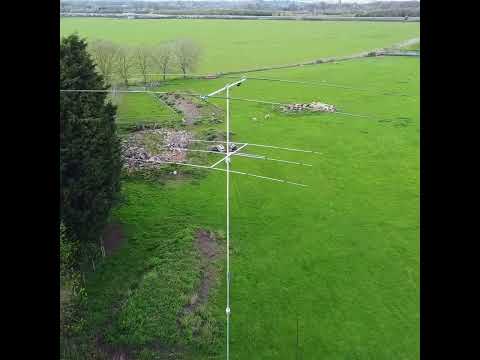
The final lift after mast was destroyed.
 The YouTubers Bunch
Callum’s Videos
The final lift after mast was destroyed.

Project X has officially started… although I’m not telling you what it is just yet! First job: make some room. In this video I head out into the field to dismantle an experimental 15/12/10m vertical antenna that’s been standing here for the last couple of years. It was a surprisingly effective little system, using three vertical elements and a shared radial/guy arrangement, so before taking it apart I give you a closer look at how it worked.
I also show you a very simple and inexpensive way of adding guy points to a pole.
Then we move over to another experiment: can I turn the centre mast of my 40m four-square system into a serious 160m vertical?
A bit of detective work with a multimeter reveals exactly where the unwanted short circuit is coming from – and fortunately, it looks like the solution could be relatively straightforward.
With around 700 metres of radial wire already underneath it, plus a planned 9m extension, that 160m project could become quite an antenna.
And finally… the space is cleared.
Next job: digging a hole for Project X.
I’ll reveal what Project X actually is once I know it works!
Enjoy your radio.
73
Callum – DX Commander

A proper October Shack Chat this time. I’ve been a bit quiet on YouTube over the last month, but that doesn’t mean I’ve been doing nothing. Quite the opposite really – I’ve probably had too much going on.
Radio Commander has become a bit of an obsession and I’m now starting to see how it could develop into something much bigger, particularly with Station 2 and the idea of letting a small number of operators remotely access a complete high-power station with antennas, rotator control, amplifier, cameras and everything else tied together properly.
Project X also hit a bit of a snag when I discovered one of the important components I’d originally planned to use was no longer realistically available. That’s now moving again, though, and I’ve ordered an alternative so hopefully I can finally start prototyping it properly.
I’ve also got a couple of videos sitting there waiting to be finished, including a full Ham Radio Deluxe / DM780 digital modes video and the antenna build with Craig from the DXFest raffle.
Then there’s the writing…
Callum’s Practical Antenna Handbook is still progressing, Charity and the Destiny Machine is in the editing stage, Esmeralda is still sitting there waiting for me, and I’ve somehow decided that several of the other stories rattling around inside my head might work better as short stories instead.
On top of all that, I’ve been rebuilding the deck at home, replacing bits of mast rope, looking at new bits of test gear, thinking about antennas and generally finding new ways of giving myself more things to do.
So this one is really just me sitting in the shack with a coffee, bringing you up to date with what’s happening, what’s coming next, and why my head is permanently full of projects.
Hopefully you enjoy the waffle.
73
Callum, M0MCX
DX Commander

I’ve been slightly consumed with building Radio Commander recently, so I thought I’d show you how I’ve been using AI to create my own small ham radio and shack tools.
We look at some of the little programs that eventually led to Radio Commander — including a simple CAT console, RigMirror, HamChat and Snapshot — and I demonstrate how you can start with a very small idea and use an AI assistant to help turn it into a working program.
You don’t need to be an expert programmer, but you DO need to know what you’re trying to achieve.
My biggest tip? Don’t try to build the Rolls-Royce on day one. Build the bicycle, ride it, test it — and then start adding the bells!
We also build a simple CAT control program and talk about prompting, testing, versioning, roadmaps and what to do when the AI gets something wrong.
If you’ve ever thought, "I wish I had a little program that did THIS in my shack…" — perhaps now you can build it.
73, Callum.
M0XXT / DX Commander

Meet Radio Commander — the glass-cockpit control panel I’ve been building for amateur radio stations.
The idea is simple: one clean, unified operating surface for controlling different radios without having to relearn the front panel every time. In this short demonstration, I’ll show you Radio Commander working with my Kenwood equipment, including its dual-receiver and dual-radio features.
It currently supports the Kenwood TS-990S, TS-890S and TS-590S/SG through external radio drivers, with more HF radios planned from Icom, Elecraft and Yaesu.
This is still an evolving community project, but it’s already becoming a genuinely useful part of my station.
Let me know what you think — and which HF radio you’d most like to see supported.
Download here – and select RADIO COMMANDER directory: https://mega.nz/folder/hq4mGY7Z#fSPzKPMhLIGmTnxUewZl1w
73, Callum M0XXT
DX Commander

LIVE on HF, come and play…

The power might get cut – depends if we get by lightning or not…
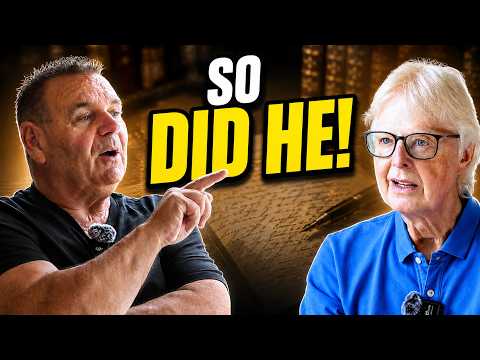
I recently met author Tom Bridge, whose first novel One Last Chance is being published by Pegasus today (at time of launching this video). As I’m also in the process of writing my own first novel, it seemed far too good an opportunity not to sit down and compare notes.
This turned into a completely unscripted conversation about what actually happens when you write fiction: inventing characters, building believable backstories, fixing plot “logic bombs”, researching real places and history, choosing titles, approaching publishers – and that slightly strange moment when your characters begin to feel like real people.
Tom talks about the process behind One Last Chance, his experience finding a publisher and what happens between finishing a manuscript and seeing an actual book appear. I also talk about my own experience writing a novel – including becoming rather more emotionally involved with my imaginary people than I ever expected!
Neither of us claims to be an expert. We’re simply two first-time authors comparing experiences – and discovering that quite a few of them were remarkably similar.
If you’ve ever had a story rattling around in your head and wondered whether you could actually turn it into a book, you may enjoy this.
Tom Bridge – One Last Chance
Publication date: 27 August 2026
Order:
https://pegasuspublishers.com/book/one-last-chance
and
https://www.amazon.co.uk/One-Last-Chance-T-L-Bridge/dp/1836715706

DXFest 2026 was our annual Open Day here at DX Commander HQ – and this year I handed the camera to Emily M6ELM!
This is her look behind the scenes at the day: meeting some of the people who travelled to see us, wandering around the antennas and stations, visiting the shack, satellite demonstrations, RSGB, QSO Director, plenty of ham radio chat – and, of course, the café!
We also put the big tower through its rather spectacular lowering routine, with an audience watching, before finishing the afternoon with our DXFest raffle – assisted by young Miles, who did an excellent job of picking the winning tickets.
A wonderfully relaxed afternoon of amateur radio, antennas, friends, food and plenty of laughs.
A huge thank you to everyone who travelled to DXFest 2026, everyone who helped make the day happen, and especially Emily for filming it.
See you next time!
73,
Callum M0XXT

I found this from an old live-stream last year. I thought it was interesting. 4-Square Antennas work best for very low angle DX. 73 Callum.